
Click The Pic!



MILAN -- Italian scientists are testing a new diet pill that turns into a clear, gelatinous blob the size of a tennis ball that may help shrink waistlines by giving dieters a sense of satiety.
The pill, currently undergoing clinical trials at Rome's Policlinico Gemelli hospital, would be downed with two glasses of water at the first sign of a stomach rumble.
"The effect is like eating a nice plate of pasta," said Luigi Ambrosio, lead researcher on the project at the National Research Council's Institute for Composite and Biomedical Materials in Naples. "If you sit down for a meal with a stomach that already feels full, you'll end up eating less."
The unnamed pill is made from a cellulose compound of hydrogel, a material that's powdery when dry but plumps up to a cousin of Jell-O when wet. The gel can soak up to 1,000 times its weight. A gram in capsule form quickly balloons from the size of a spit wad to a ball that holds nearly a liter of liquid.
Growing waistlines are an increasingly hefty issue. The World Health Organization calls
Ambrosio and fellow researcher Luigi Nicolais, now minister for reform and innovation, noticed the burgeoning girth of Americans during a trip to the United States in the '90s.
The pair had been working with a team to develop super-absorbent materials for Swedish paper-product company Sca and wondered whether a hydrogel could produce an effect similar to gastric banding -- without the surgery.
Along the way, they discovered the spongelike material could be used to treat edemas, and are currently experimenting with it as a way to slow-water plants. The versions of the material for use in the diet pill is biocompatible, so the body just flushes it out, the scientist say.

Jelly belly: from about the size of a spit wad the compound grows to a tennis ball so dieters sit down feeling full.
But in a market glutted with miracle cures and trendy diets, some folks don't gel with the concept.
Lona Sandon, a dietitian at UT Southwestern Medical Center in Dallas, sighed slightly before commenting.
"I don't think we'll find the answer to obesity in a pill," said Sandon, who is also a spokeswoman for the American Dietetic Association. "The only long-term solution is cutting back calories and getting exercise."
Though it may not be a magic bullet, some experts think it could help those whose girth has already grown out of control.
"A pill like that one could be a valid aid when you've already got a serious problem," said professor Antonino De Lorenzo of Rome's Tor Vergata University, who has conducted extensive research on benefits of the classic Mediterranean diet. "The real challenge is teaching people to eat properly before they need it."
If trials are successful, researchers hope to put the gel pill within easy reach of calorie counters on both the EU and North American markets in about a year.
"Obesity is such an enormous problem," said Ambrosio. "If we managed to reduce it by even 10 percent with this pill, it would be a huge accomplishment."

UNIVERSITY PLACE, Wash.– Passengers on a Continental Airlines flight had to hold their noses for hours as sewage overflowed from toilets while they were high over the Atlantic.
"To be blatantly honest, I was more nervous than I had ever been on a flight," said Collin Brock. The University Place man was on board Continental Airlines flight 1970 from Amsterdam to Newark, New Jersey last week when things went bad.
"I've never felt so offended in all my life. I felt like I had been physically abused and neglected. I was forced to sit next to human excrement for seven hours," said Brock.
That's after lavatories - in the middle of a flight filled with passengers - started spewing sewage.
"Sickening. It's a nauseating smell. It's very uncomfortable," said Brock.
It was last Wednesday afternoon when his flight left Amsterdam, but roughly two hours into it, the passengers were told the lavatories were out of commission. An unplanned landing in Shannon, Ireland was made to fix the problem.
A pit stop became an overnight stay. The next day, the same plane headed for its original destination of Newark, New Jersey, but just after takeoff, the sewage overflow began. This time, there was no turning around.
"I don't know how you can say a plane needs to be grounded one day for a problem that's not as major as a problem the next day, and it doesn't qualify for being grounded," said Brock.
He says was there was one partially-working restroom on the plane for the more than 200 people onboard.
He also says the flight attendants - who were serving meal service in a stinky, unappetizing cabin - told everyone to not eat or drink too much.
"To be told that we were supposed to monitor what comes out the other end of us was insulting," said Brock. "Shame on continental. It was the worst flight experience I have ever had."
Continental gave Collin a $500 voucher for a future flight for the inconvenience. He says he's not sure he'll ever use it.
Animal control officers tried coaxing the gray tabby with encouraging words and food Monday afternoon before giving up after about an hour and a half.
Parkersburg firefighters tried banging tools on one end of the pipe and flashing lights Monday night near the Parkersburg-Belpre Bridge in hopes of driving him out the other end, but that failed.
Only when firefighters flushed about 250 gallons of water_ enough to wet the kitten's paws — through the pipe that the feline rushed into the hands of Firefighter Kevin Siers, who was standing inside a manhole.
"We had about an hour and a half of fun," Siers said Tuesday. "Everybody was pretty tickled" when the cat emerged.
After a very frightening day and night, the kitten seemed more relaxed on Tuesday and was warming up to humans, said Dan Hendrickson with the Humane Society of Parkersburg. A visitor to the shelter was signing adoption papers Tuesday afternoon.
Siers and state Fire Marshal Sterling Lewis said it is not uncommon for fire departments to attempt such rescues.
Firefighters have rescued iguanas off of telephone poles, snakes out of sewer pipes and cats out of trees, Siers said.
"Firefighters will go try to save anything," Lewis said.
Somerset police said the man reported the bizarre burglary on Monday. He told investigators someone broke into his apartment while he went to a nearby tavern. Nothing but the salad was missing, police said.
Police said they have a suspect and expect to file charges once they finish their investigation.
Information from: The Tribune-Democrat, http://www.tribune-democrat.com
SANTA FE, N.M. - A strange image captured by a surveillance camera at the First Judicial District courthouse downtown has left sheriff's deputies, lawyers, clerks and judges scratching their heads.
Some think it's a ghost. Others suggest it's a reflection from a passing car or possibly a piece of fluff from a cottonwood tree.
"I don't know what it is, but I think it's neat that it showed up on a Friday," said Sally Saunders, assistant to District Judge Stephen Pfeffer. "Now we have something to talk about."
Santa Fe County Deputy Alfred Arana first noticed the image when he arrived at the courthouse Friday morning and began reviewing surveillance video from the night before. Sgt. Vanessa Pacheco arrived a half hour later and was asked by Arana to watch the video.
"It's something unexplainable," Pacheco said. "I don't believe in ghosts so I don't think that's what it is."
The video shows a bright spot of light coming from either the roof or near the courthouse's back door. It moves toward the west across the front bumper of a parked police before leaving the frame.
Perhaps the most bizarre part is that the light appears to cast shadows.
Courthouse workers debated whether it might have been a reflection. But some said the angle of the sun wasn't right and a large tree shades most of the area.
Arana said the footage was clearer when he first watched it than when it was replayed over and over Friday. He said he had no idea what the camera captured.
Deputy Anthony Maes said it was a ghost. "What makes us think we're the only beings on this planet? It's too weird," he said.
Maes said he thought it might be the ghost of convicted murderer Andy Lopez, who took nine people hostage at the courthouse in February 1985 before being shot by a deputy as he peeked out the back door.
Candy Sisneros, a clerk, said her husband, a sheriff's deputy, used to work in the courthouse at night when the county's dispatch center was there, and he used to hear footsteps, doors opening and closing and elevators going up and down.
Jude Torres has worked at the court house as a janitor for four years and said he sometimes hears noises at night. He said the noises mainly originate from the same side of the building where the light was seen.
Earl Rhoads, a public defender, thinks the image is that of a drifting cottonwood seed.
"I'm not willing to say it's proof of paranormal activity," he said. "I think it's totally explainable."
On the Net:
Link to courthouse video: http://www.freenewmexican.com/news/63222.html
SAN FRANCISCO — Has online retailing entered the Dot Calm era?
Since the inception of the Web, online commerce has enjoyed hypergrowth, with annual sales increasing more than 25 percent over all, and far more rapidly in many categories. But in the last year, growth has slowed sharply in major sectors like books, tickets and office supplies.
Growth in online sales has also dropped dramatically in diverse categories like health and beauty products, computer peripherals and pet supplies. Analysts say it is a turning point and growth will continue to slow through the decade.
The reaction to the trend is apparent at Dell, which many had regarded as having mastered the science of selling computers online, but is now putting its PCs in Wal-Mart stores. Expedia has almost tripled the number of travel ticketing kiosks it puts in hotel lobbies and other places that attract tourists.
The slowdown is a result of several forces. Sales on the Internet are expected to reach $116 billion this year, or 5 percent of all retail sales, making it harder to maintain the same high growth rates. At the same time, consumers seem to be experiencing Internet fatigue and are changing their buying habits.
John Johnson, 53, who sells medical products to drug stores and lives in San Francisco, finds that retailers have livened up their stores to be more alluring.
“They’re working a lot harder,” he said as he shopped at Book Passage in downtown San Francisco. “They’re not as stuffy. The lighting is better. You don’t get someone behind the counter who’s been there 40 years. They’re younger and hipper and much more with it.”
He and his wife, Liz Hauer, 51, a Macy’s executive, also shop online, but mostly for gifts or items that need to be shipped. They said they found that the experience could be tedious at times. “Online, it’s much more of a task,” she said. Still, Internet commerce is growing at a pace that traditional merchants would envy. But online sales are not growing as fast as they were even 18 months ago.
Forrester Research, a market research company, projects that online book sales will rise 11 percent this year, compared with nearly 40 percent last year. Apparel sales, which increased 61 percent last year, are expected to slow to 21 percent. And sales of pet supplies are on pace to rise 30 percent this year after climbing 81 percent last year.
Growth rates for online sales are slowing down in numerous other segments as well, including appliances, sporting goods, auto parts, computer peripherals, and even music and videos. Forrester says that sales growth is pulling back in 18 of the 24 categories it measures.
Jupiter Research, another market research firm, says the growth rate has peaked. It projects that overall online sales growth will slow to 9 percent a year by the end of the decade from as much as 25 percent in 2004.
Early financial results from e-commerce companies bear out the trend. EBay reported that revenue from Web site sales increased by just 1 percent in the first three months of this year compared with the same period last year. Bookings from Expedia’s North American Web sites rose by only 1 percent in the first quarter of this year. And Dell said that revenue in the Americas — United States, Canada and Latin America — for the three months ended May 4 was $8.9 billion, or nearly unchanged from the same period last year.
“There’s a recognition that some customers like a more interactive experience,” said Alex Gruzen, senior vice president for consumer products at Dell. “They like shopping and they want to go retail.”
The turning point comes as most adult Americans, and many of their children, are already shopping online.
Analysts project that by 2011, online sales will account for nearly 7 percent of overall retail sales, though categories like computer hardware and software generate more than 40 percent of their sales on the Internet.
There are other factors at work as well, including a push by companies like Apple, Starbucks and the big shopping malls to make the in-store experience more compelling.
Nancy F. Koehn, a professor at Harvard Business School who studies retailing and consumer habits, said that the leveling off of e-commerce reflected the practical and psychological limitations of shopping online. She said that as physical stores have made the in-person buying experience more pleasurable, online stores have continued to give shoppers a blasé experience. In addition, online shopping, because it involves a computer, feels like work.
“It’s not like you go onto Amazon and think: ‘I’m a little depressed. I’ll go onto this site and get transported,’ ” she said, noting that online shopping is more a chore than an escape.
But Ms. Koehn and others say that online shopping is running into practical problems, too. For one, Ms. Koehn noted, online sellers have been steadily raising their shipping fees to bolster profits or make up for their low prices.
In response, a so-called clicks-and-bricks hybrid model is emerging, said Dan Whaley, the founder of GetThere, which became one of the largest Internet travel businesses after it was acquired by Sabre Holdings.
The bookseller Borders, for example, recently revamped its Web site to allow users to reserve books online and pick them up in the store. Similar services were started by companies like Best Buy and Sears. Other retailers are working to follow suit.
“You don’t realize how powerful of a phenomenon this new strategy has become,” Mr. Whaley said. “Nearly every big box retailer is opening it up.”
Barnes & Noble recently upgraded its site to include online book clubs, reader forums and interviews with authors. The company hopes the changes will make the online world feel more like the offline one, said Marie J. Toulantis, the chief executive of BarnesandNoble.com. “We emulate the in-store experience by having a book club online,” she said.
The retailers that have started in-store pickup programs, like Sears and REI, have found that customers who choose the hybrid model are more likely to buy additional products when they pick up their items, said Patti Freeman Evans, an analyst at Jupiter Research.
Consumers are generally not committed to one form of buying over the other. Maggie Hake, 21, a recent college graduate heading to Africa in the fall to join the Peace Corps, said that when she needs to buy something for her Macintosh computer, she prefers visiting a store. “I trust it more,” she said. “I want to be sure there’s a person there if something goes wrong.”
Ms. Hake, who lives in Kentfield, Calif., just north of San Francisco, does like shopping online for certain things, particularly shoes, which are hard to find in her size. “I’ve got big feet — size 12.5 in women’s,” she said. “I also buy textbooks online. They’re cheaper.”
John Morgan, an economics professor from the Haas School of Business at the University of California, Berkeley, said he expected online commerce to continue to increase, partly because it remains less than 1 percent of the overall economy. “There’s still a lot of head room for people to grow,” he said.


(thanks, kevin, jason, kevin, big fez, Noella)
posted by Xeni Jardin
 "PacMan’s skeleton, conceived by Le Gentil Garçon, in collaboration with François Escuilié, palaeontologist, from the comparative observation of human and various predatory animal skulls. 2004, Resin, diameter: 65 cm."
posted by David Pescovitz
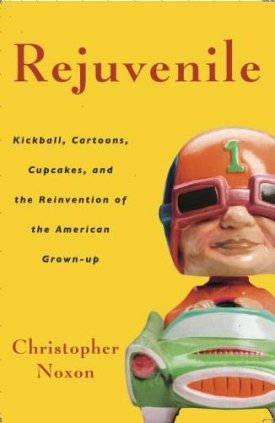
Noxon wants to know why America's adults increasingly dress up as Klingons, collect dolls and action figures, participate in urban pillow fights, play RPGs (fantasy and massively multiplayer), participate in crafts, read comics, and hang out on the carpet with the kids and the legos instead of plopping the kids into a playpen and then settling in with a martooni.
He tracks the early history of the "rejuvenile" movement back to Lord Baden-Powell's pitch to potential Scout-masters to become "boy-men" in the woods with their young charges, through boomer entitlement, and to a new generation who, driven by a mad housing market and a lunatic job-market, find themselves holding off on kids and marriage through their thirties.
Written as a series of fun case-studies of grown-ups who won't grow up (a woman who attained brief fame by skipping everywhere she went, a man who tried unsuccessfully to get his son to play with his Star Wars action figures) in some way or another, Rejuvenile is a thoroughly affectionate look at the breaking down of the barriers between adulthood and kidhood.
I was utterly charmed. Here was a book that pulled together a ton of diverse threads -- friends who spend their weekends at American Coaster Enthusiast events, haunting eBay auctions for access to the lost toys of my boyhood, and that floating D&D game I keep trying to squeeze into my schedule.
Noxon's style is breezy and his touch is light, but he doesn't shrink from the harder questions of protracted adolescence. If your desk is covered in vinyl toys and Schoolhouse Rock nodders, this book will probably mean a lot to you.
Link







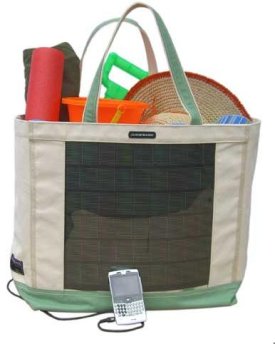 The Juice Bag is a beach tote with an integrated solar panel that will charge your phone, camera, laptop and MP3 player while you manufacture vitamin D.